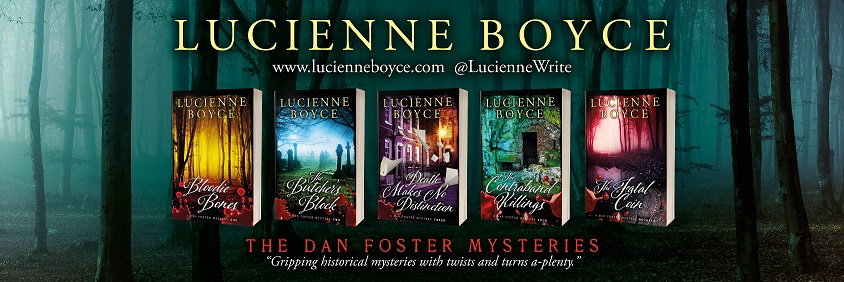
The Contraband Killings Blog Tour 5 - 11 December 2022

The Contraband Killings: A Dan Foster Mystery is on a blog tour this week (5-11 December 2022). The tour will feature unique extracts, reviews and guest blogs. The schedule is below, and the links will go live as the blogs are published.

Anglesey 1799: Bow Street Runner Dan Foster is sent to fetch smuggler Watcyn Jones from prison on Anglesey to stand trial for murder at the Old Bailey in London. When the prison escort is ambushed and Watcyn Jones escapes, a straightforward prison transfer turns into a desperate manhunt.
 
As Jones’s enemies start to die, the chase becomes more urgent than ever – and Dan’s chances of getting off the island alive begin to look far from promising.

Out now at Amazon (Amazon.co.uk and Amazon.com).


Blog Tour Schedule

Monday 5 December 2022

Jera's Jamboree  - Review. 

Northernreader

The Book Decoder - Review

Tuesday 6 December 2022

Kathryn Books - Review

Sharon Beyond the Books - Review

Celticlady's Reviews 

Wednesday 7 December 2022

Jaffa Reads Too - Review

Broad Thoughts From a Home - Review 

Chez Maximka - Guest Blog "A Pedestrian in Wales" - walking holidays in the eighteenth century.

"Travellers will be travellers, and one thing many of them love to do is write a book about their adventures when they get home." 

Thursday 8 December 2022

One Creative Artist (Instagram)

It Takes a Woman - Review

The Magic of Wor(l)ds - Extract

Friday 9 December 2022

Book Reviews by Taylor - Review

Ginger Book Geek - Review

Chicks, Rogues and Scandals

Saturday 10 December 2022

Miriam Smith45 - A Mother's Musings (Instagram) - Review

Books by Bindu - Extract

Satisfaction for Insatiable Readers - Extract

Sunday 11 December 2022

Lyndas_bookreview (Instagram) - Review

Novel Kicks - Extract

Mrsbookburnee (Instagram) - Review

 
With thanks to the blog tour organiser, Rachel's Random Resources.
 
And special thanks to all the lovely book bloggers and bookstagrammers!


Comments

Popular posts from this blog

'We will have a fire': arson during eighteenth-century enclosures

Join our Winter Solstice Blog Hop! Thirty writers throw light on a dazzling range of topics . Follow the links at the end of this article to be enlightened and brightened by our blogs...  “Inclosure came and trampled on the grave Of labours rights and left the poor a slave And memorys pride ere want to wealth did bow Is both the shadow and the substance now.”    John Clare, The Mores     On 1 May 1794, the writer Hester (Thrale) Piozzi of Streatham Park recorded in her diary that the furze on the common had been set on fire in protest at the enclosure of land “which really & of just Right belonged to the poor of the Parish”. Yet even while she acknowledged that the protesters had justice on their side, she criticised them for not “going to Law like wise fellows” and concluded: “So senseless are Le Peuple , & so unfitted to be souverain”. The senseless poor of Streatham were not unique. During the eighteenth centu...

My blog has moved to https://lucienneboyce.com/blog/

My blog has moved to my new website and is now at https://lucienneboyce.com/blog/  I'm no longer posting blogs on this site, but you can still read the old blogs on this site, or you can find them at the new location.     

From Hogarth to Rowlandson: Medicine in Art in Eighteenth Century Britain, Fiona Haslam, (Liverpool University Press, 1996)

I’m often asked about how I go about doing the research for my historical novels. One of the sources I usually mention is visual art. I’ve always found that looking at contemporary paintings, prints, sketches, sculpture and so on reveals a wealth of information about how people of the past lived – what they wore, what sort of houses they lived in, how they spent their time, the towns and villages they inhabited. Going to an art gallery is one of my favourite research trips – especially if there’s a decent café with tea and cake at the end of an afternoon’s study! Of course, you don’t always have to take artistic representations literally. It’s obvious that whatever you’re looking at is an interpretation of the reality: it’s how the artist saw it. In fact, this subjectivity can be a real advantage if you’re looking for ideas about how people lived and thought. Often the most exaggerated representations, such as satirical prints or caricature, are the most revealing, telling us thi...